You are here
Advantages of outsourcing
Submitted by gc on Mon, 02/18/2013 - 10:04
Outsourcing offers numerous advantages to the customers, some of which have been elaborated below:
- Focus on core competencies: Outsourcing enables customers to divert their attention from supplementary tasks and focus on their core functions. Customer care, documentation, IT up gradation and administrative tasks such as internal audit and payroll processing are the non-core tasks for many companies and consume the time of the management if handled in-house. When these tasks are outsourced, the company management can focus on the company’s core competency and bring better services and products into the market. For example Hero Honda Motors outsources its IT maintenance work so that its staff can focus on user requirements to deliver better services instead of spending time on routine complaints.
- Cost savings: Cost savings is an important consideration in outsourcing decision. Outsourcing enables companies reduce their costs on resource management, labor, space, etc. According to Accenture, outsourcing leads to a cost saving of 25 percent to 30 percent. Outsource Partners International estimates the cost savings to reach up to 50 percent when the outsourced work is offshored. Sparkasse Leipzig, a German savings bank, has outsourced its IT-related work to Siemens Business Services for a cost of 30 million euros. Reduction in IT costs and harnessing Siemens’ advanced technology were the driving factors for this deal for Sparkasse Leipzig.
- Quality: Vendors have expert employees along with specialized processes and technology that ensure better quality of output for the customer. However, the customer has to carefully select a vendor that will provide it with the quality of services that it requires.
- Flexibility: Outsourcing provides flexibility to the customer as the buyer can change a vendor if required. Changing a vendor in case of poor delivery is much easier than changing a full-time employee. Many outsourcing deals incorporate conditions for change in requirement or termination of contract ensuring flexibility.
- Time-to-market: Offshore outsourcing offers round the clock work benefits and hence reduces the time-to-market. Both on-shore and offshore outsourcing may also result in time saving if the vendor has skills and expertise that are not internal to the customer organization. Outsourcing also enables faster start-up, development and scalability for new operations.
- Access to diverse technologies: Vendors have focus on particular services and play in volume. This enables them to keep themselves up-to-date with the technology required in these services. The customer can thus avoid technology obsolescence and leverage the vendor’s access to diverse and advanced technologies.
In addition to the above advantages, outsourcing offers other benefits such as provider alternatives, transfer of risk to vendor, elimination of internal policies, elimination of recruitment, training and staff retention in non-core functions, and scalability (faster scale-up or scale-down capability).
According to Deloitte Consulting Outsourcing Study, October-December 2004, lower cost was the most vital reason given by the respondents for choosing the outsourcing option. The survey findings are shown in Figure 1 (the numbers do not add up to 100 as the survey participants were not limited to one option).
Figure 1: Reasons for outsourcing 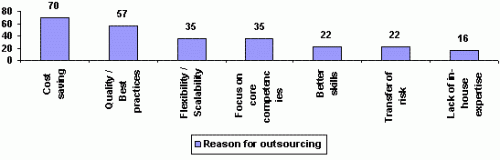
Source: Deloitte Consulting
Read on Kindle
Please consider leaving us a review on Amazon if you like it.
Wireless Networking: Introduction to Bluetooth and WiFi

